en English
Should You Avoid Farmed Fish English subtitles
Report a problem
Advertisement
English transcript
This episode of Dnews is brought to you by Audible.
Cows are farmed, pigs are farmed, plants are farmed… and there's a debate about the health
benefits of ALL of those things. So what about fish? Is farming fish okay?
We learned to fish long before we learned farming or domesticating animals, and today,
we eat so much fish, there's no way we can catch all those animals and keep the practice
both sustainable and affordable… So we farm them. That alone isn't terrible, but HOW it's
done can sometimes be. In 2012, global fish farming, called aquaculture, passed global
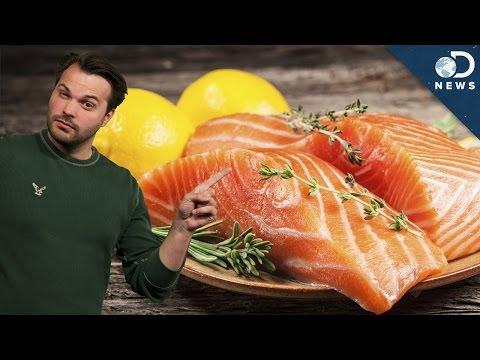
BEEF production. But have you noticed farmed salmon and wild salmon look different? The
wild are orange-pink and the farmed are light pinkish, not quite orange.
Salmon are carnivorous fish. In the wild they eat smaller fish, so they can't be fed grains
or soya on farms, they need to eat other fish to survive. Farmed fish don't get the same
nutritional input as wild fish, obviously. Salmon meat gets the orange-pink color from
eating tiny shrimps and other crustaceans -- the shells of which contain carotenoids,
an antioxidant which is the same stuff that makes carrots orange. According to Stanford's
Center for Environmental Science and Policy, one pound of salmon takes about 2.4 pounds
of other wild fish to produce -- usually sardines, anchovies, mackerel, herring and so on. But
since farmers have to make the feed for their fish, they grind up the smaller ones to produce
fish oil and meal, and compress it into pellets that can be fed to the salmon. Obviously,
some carotenoids are added too, because the fish need them for growth and reproduction,
as well as color.
Since 2004, the World Wildlife Fund has worked with salmon farmers to make the farming sustainable
and fight disease. And, the Monterey Bay Aquarium Seafood Watch program is taking note of improvements
in the aquaculture industry noting there are a couple of places where salmon farming is
done right.
But some farmers are replacing the fish oil in the feed with vegetable oil, which is cheaper
and more sustainable. And a new study from Norway's National Institute of Nutrition and
Seafood Research has found this practice might be harming the fish AND those eating it. According
to their results, Norwegian farmers were replacing as much as 2/3 of the salmon's oil with veggie
in 2013. They were quick to point out, this was just Norway, not everywhere.
To see how this major dietary change would affect the salmon and thus the people eating
it, they fed the salmon to mice… Turns out, those who ate the fish-oil salmon had a healthy
balance of omega-3 and omega-6 fatty acids, and a healthy liver; even though they ate
a LOT of salmon. On the other hand, those who ate the vegetable-oil salmon did not have
a healthy balance of fatty acids and had an accumulation of fat in their liver called
nonalcoholic fatty liver disease.
So maybe farmed salmon isn’t quite as healthy. But wild salmon are still really expensive,
three times as much as farmed salmon in some markets. However many farmers are banding
together to make salmon farming sustainable, affordable and good for the fish and the future.
The Norwegian researchers closed it best, saying yes, the vegetable oil-fed fish weren't
as healthy, but "getting some omega-3 acids are better than none at all."
How do you feel about fish farming? Better or worse than regular farming?