en English
Are Babies Healthier When They Come Out Of A Vagina English subtitles
Report a problem
Advertisement
English transcript
Chronic diseases like asthma diabetes are on the rise, could c-sections be to blame?
We’ve talked a lot about the microbiome here on DNews. Researchers think that the
bacteria that live in and on us play crucial roles in our lives and that an imbalance of
microbes might lead to chronic diseases. Our first microbes actually come from our moms
when we’re born. But some kids born via c-section are missing out on those microbes.
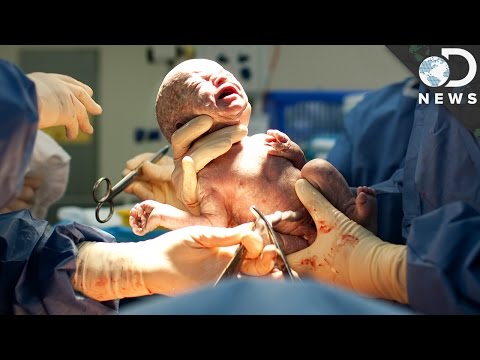
This is because the c-section procedure, or cesarean section, is when a baby is delivered
through a surgical incision in the mother's abdomen and uterus. And because these babies
are not going through the vagina, the important microbes or researchers call them “natural
primordial bacteria” are not transferred to the baby.
So that’s why doctors are swabbing babies born via c-section with their mother’s vaginal
microbes in a procedure called microbial transfer. Before the C-section, doctors swab the mother’s
vagina with a sterile gauze, then two minutes after the birth, the baby will be thoroughly
wiped all over with with the microbe laden gauze.
In a small study published in the journal Nature Medicine scientists reported the results
of such procedures. The researchers looked at the microbe make-up of 18 babies a month
after birth. 7 were delivered vaginally and 11 were born via c-section. and 4 of those
who were born via c-section received a microbial transfer. The researchers found that those
4 babies had skin, gut, anal and oral microbe make-ups similar to babies born through vaginal
birth.
One of the authors of the study Rob Knight believes that before this kind of surgery,
“every surviving mammal that was delivered into the world was essentially coated in its
mother’s vaginal community.” So it makes “evolutionary sense” that these microbes
could play a vital role in our health.
Babies need microbes because they train our immune system to fight disease and recognize
what is harmful and what is harmless. An untrained immune system can be overly sensitive and
react to benign substances like pollen and dust, which can lead to asthma. And without
the initial mixture of mom’s microbes, our gut microbes can get out of balance leading
to ulcerative colitis (and crohns disease?). Without these microbes, our metabolism could
be altered, leading to obesity. Basically, your mom is helping you out from the start
by passing on these microbes to you.
And these kind of chronic diseases are on the rise, as are the rates of cesarean sections.
C-sections births in the United States rose by over 25% in the last 50 years..
So if you’re one to make leaps of logic, you might get where I’m going here. Although
correlation does not necessarily mean causation. A study published in the journal Clinical
and Experimental Allergy found that infants born through C- section were a whopping 20%
more likely to develop asthma later in life. And a study published in the British Medical
Journal found that kids who were born via C-section had a higher obesity rate of 19.4
percent versus the obesity rate among kids delivered vaginally, which is 15.8.
So maybe microbial transfers can curb the rise of some of these chronic diseases. While
the first study was small, a new study is in the works that will follow 75 babies a
year after birth, with plans for an even larger study following 1200 children for at least
3–5 years. So what I’m saying is, more research is needed.
If you love microbes as much as I do why don’t you start your own website at ilovemicrobes.co
or magnificantmicrobes.com check out those available domains and more over at domain.com
No domain extension will help you tell your story like a DOT COM or DOT NET domain name.
And because you watch DNews, you can get 15% off Domain Dot Com’s names and web hosting
by using the code DNews when you check out.
So what does bacteria do for us? Find out how these little guys do some very important
work in this episode right here