en English
Developing a Candidate Ebola Vaccine English subtitles
Report a problem
Advertisement
English transcript
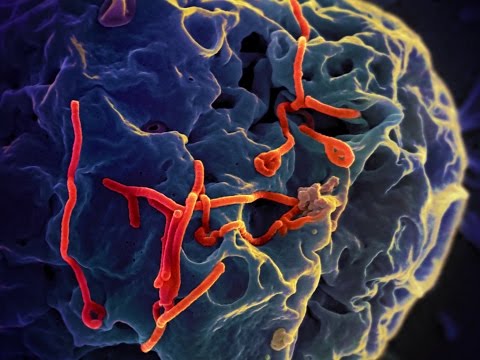
Ebola virus was discovered in 1976
after two deadly outbreaks in Central Africa.
Since then, Ebola viruses have emerged periodically
in this and other regions of the continent. In 2014,
a large outbreak of Ebola struck Guinea, Liberia,
and neighboring countries in West Africa, killing thousands of people
and threatening to destabilize these developing nations.
"We're in the middle of a cataclysmic outbreak in West Africa."
Dr. Anthony Fauci is the director of the National Institute of
Allergy and Infectious Diseases,
or NIAID, where scientists are spearheading efforts to develop
Ebola vaccines and treatments as quickly as possible.
"As this epidemic now has become
most extraordinary in its historic
scope, it is entirely conceivable that,
despite the infusion of resources for classical
infection control, with identification, isolation, contact tracing,
we may actually need a safe and effective vaccine to actually
end this epidemic in West Africa." Several Ebola vaccine candidates
are undergoing testing in people after proving to be effective
in animals.
One of these products is an experimental vaccine developed by
researchers at NIAID's Vaccine Research Center.
It uses a chimpanzee cold virus to deliver a small piece of Ebola
genetic material to the body.
Dr. Nancy Sullivan is one of the researchers developing the vaccine.
"That piece of Ebola virus mimics
the protein that's on the outside of the virus, so when the vaccine is given,
it fools the person's immune system into thinking
that it's infected, but in fact it's not infected.
The vaccine is not made out of virus. It just contains a very small piece
of the virus."
NIAID has partnered with pharmaceutical company GlaxoSmithKline
to advance the vaccine through clinical trials, beginning with Phase 1 safety
testing at the National Institutes of Health
and expanding to additional sites in the United States and abroad.
Researchers hope to advance the vaccine through all three phases of clinical
testing
to ensure that it is both safe and effective in preventing
Ebola infection.
NIAID will continue to work with industry and government partners to
accelerate efforts to develop Ebola vaccines and treatments
in a way that is both scientifically and ethically sound.
"When you have a trial of a vaccine,
the first thing you show in Phase 1 is safety. If it's safe,
then you want to show that it induces the kind of response that you would predict
would be protective.
Once you establish that initial safety, then you go into a much larger trial
that defines the efficacy: Does it really work
under conditions of the disease outbreak? So it's a multistep process
that's tried and true and has proven to be
effective historically with many vaccines."